Bow Stabilizer — 3K Carbon Rod, Stainless Counterweight, 5 Lengths
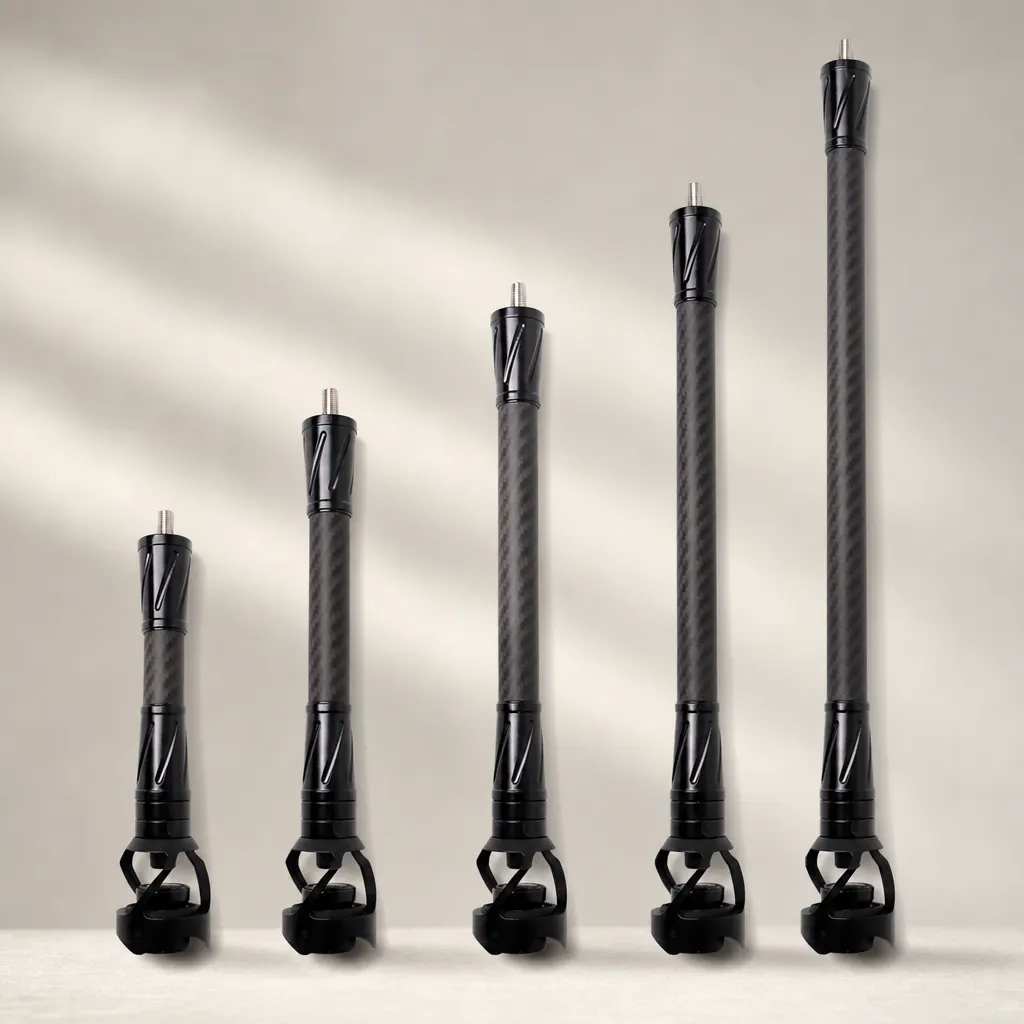
The SteadyDraw bow stabilizer puts real mass where it does the work: a stiff 3K carbon fiber rod, a detachable stainless steel counterweight, and a built-in damping ball. Steadier aim, less pin float, a quieter shot — in the length that matches how you shoot, from a 6-inch hunting bar to a 15-inch target bar.
🚨 Only a few left in stock
✓ free shipping to 18 countries ✓ 30-day money-back guarantee
Why your sight pin floats — and what weight in front of the riser changes
If you have ever settled your pin on a target and watched it trace lazy figure-eights instead of holding still, you already know the problem a stabilizer exists to solve. A bare bow is light and top-heavy with accessories — sight, rest, quiver — hanging off one side of the riser. Every tiny correction your bow hand makes at full draw gets amplified, and the pin drifts. Archers call it pin float, and no amount of gritting your teeth holds it still, because the fix is physics, not effort.
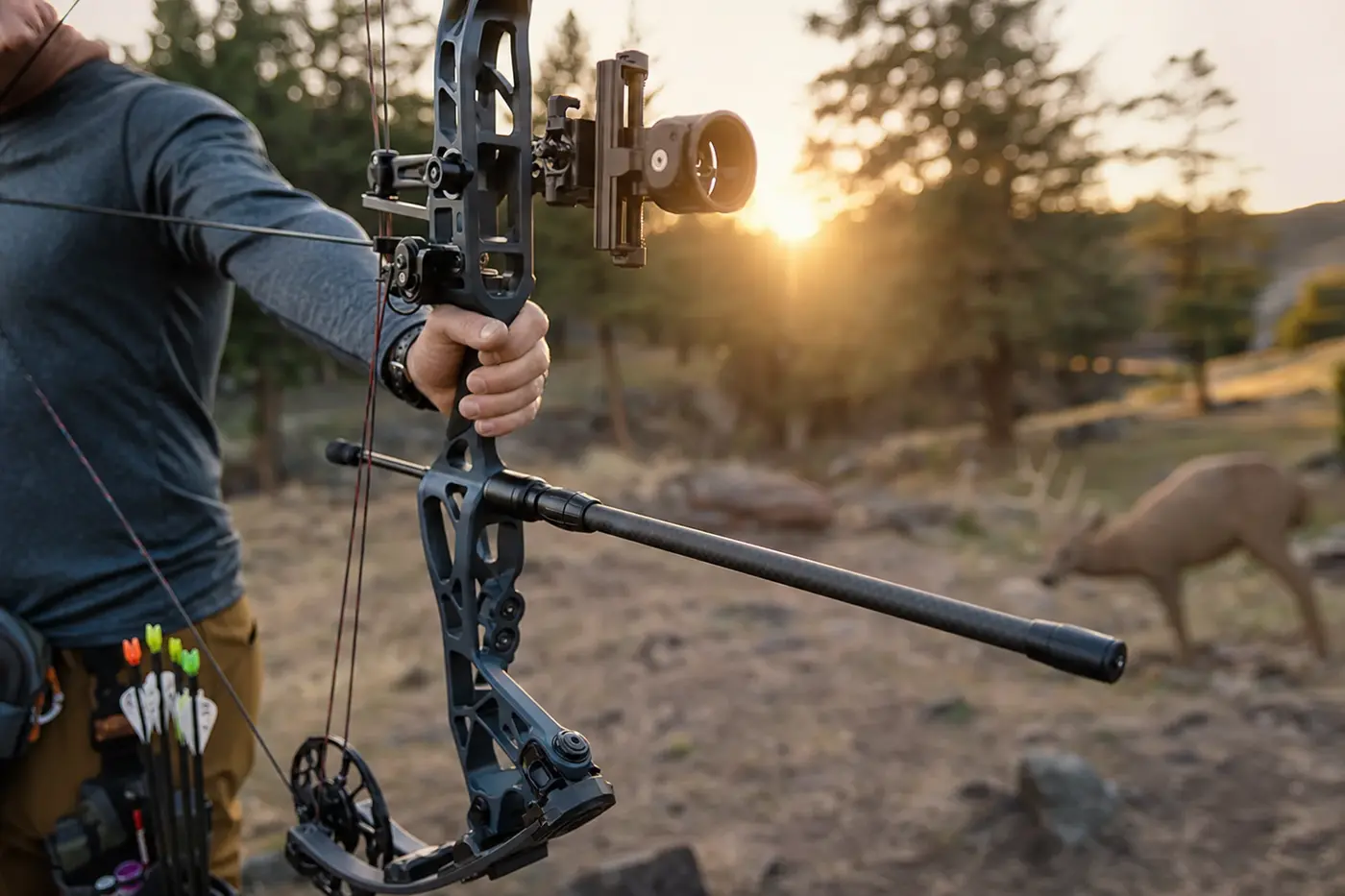
Threading weight onto the stabilizer bushing at the front of the riser changes the equation. The added mass raises the bow's resistance to rotation, so the same small muscle tremors move the pin less. The farther out that mass sits, the more leverage it has — which is why target archers run long bars and why even a compact 6-inch bar makes a bare hunting bow noticeably calmer at anchor. If you want the full mechanics, our guide on what a bow stabilizer does walks through it step by step.
The second job happens after you release. The energy that doesn't go into the arrow goes into the riser as vibration — the buzz you feel in your hand and the hum a whitetail hears at thirty yards. The SteadyDraw's stainless steel counterweight has a built-in weight damping ball for exactly this: soaking up post-shot vibration so the bow settles quietly instead of ringing. That matters twice as much on a hunting setup, where noise is the difference between a shot opportunity and a white flag bounding away.
One honest caveat before anything else on this page: a stabilizer will not fix a rough release, a collapsing anchor, or a grip you're strangling. It makes a repeatable shot easier to repeat — that's the whole promise, and it's enough. Whether you shoot a compound, a modern recurve, or split your season between the range and a treestand, the question isn't whether weight out front helps. It's which length fits the way you shoot — and that's a question this page answers with numbers, not slogans.
One stabilizer build, four details that matter
3K carbon fiber rod
The main tube is 3K carbon fiber — the stiffness-to-weight combination that dominates stabilizer rods at every price point above the bargain bin.
A stabilizer rod has one structural job: hold the counterweight rigidly out in front of the riser without flexing or adding dead weight where you don't want it. Carbon does that better than aluminum at the same mass, which is why the premium brands standardized on it years ago. The 3K weave is visible on the rod itself. Wall thickness and modulus figures aren't published for this rod, so none are quoted here.
Detachable counterweight, built-in damping ball
The mass sits at the end of the bar where leverage does the work: a stainless steel counterweight with a built-in weight damping ball, and the whole piece is detachable.
The published weights make the design obvious: the weight spread between the shortest and longest bar is only 32.5 g, because the counterweight — not the rod — carries most of the mass. Detachable means tunable: shoot with it on for maximum steadiness, pull it for a lighter feel in the field, and let your pin tell you which configuration wins — our step-by-step setup guide covers exactly how. The damping ball built into it is what you feel after release — less hand buzz, a quieter settle.
Universal screw fittings
A standard, universal-size screw fitting, per the spec sheet — the bar threads into the standard stabilizer bushing at the front of your riser.
No adapters, no compatibility chart to squint at. If your bow has a stabilizer bushing — and every mainstream compound plus virtually every modern target recurve riser does — the SteadyDraw threads in hand-tight in under a minute. That includes ILF target risers, which is why longer lengths are a common pick for recurve and target archery setups. The only bows genuinely left out are traditional one-piece wooden bows, which have no bushing at all.
Five lengths, one honest price ladder
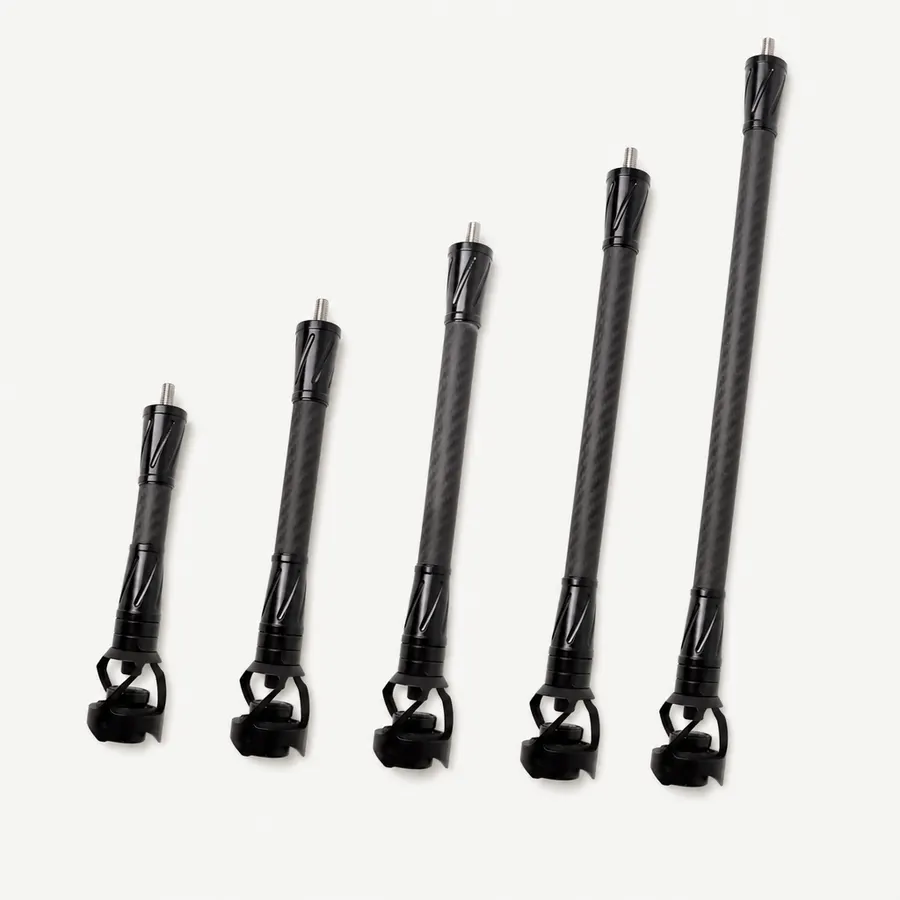
Same rod, same detachable counterweight with its built-in damping ball, in every length — 6, 8, 10, 12 and 15 inches — so you pick by how you shoot, not by trim level.
Most budget listings force a choice between one or two lengths; most premium lines price each length like a separate product. SteadyDraw runs one build across five lengths from $49.95 to $59.95: 6-inch and 8-inch for hunting rigs that need to clear blinds and brush, 10-inch as the do-it-all middle, 12-inch and 15-inch for target lines and 3D courses where leverage beats maneuverability. Our length guide goes deeper if you're torn between two.
SteadyDraw vs. premium brands vs. generic bars — the version
Ask any archery forum whether a $100+ stabilizer beats a $30 one and you'll get a food fight. Here's the category read spec by spec, row by row, with SteadyDraw's actual numbers in the middle column. We positioned it deliberately, and this table is the reasoning in the open.
| What you're comparing | Generic import bars ($25–45) | SteadyDraw ($49.95–59.95) | Premium US brands ($60–120+) |
|---|---|---|---|
| Rod material | Mixed — aluminum or unbranded carbon, specs often vague | 3K carbon fiber rod, stainless steel counterweight | High-modulus carbon, tightly specified |
| Weight tuning | Usually a fixed, non-adjustable weight | Detachable stainless counterweight with built-in damping ball | Modular ounce-by-ounce weight kits — the widest tuning range |
| Length choice | Often one or two lengths per listing | Five lengths, 6 to 15 inches, same build throughout | Broad hunting and target lines, sold as separate products |
| Support & returns | Marketplace seller policies — hit or miss | 30-day money-back, free shipping, one accountable brand | Dealer networks, strong warranties, pro-shop support |
| Who it's for | Tightest budgets, tempered expectations | Shooters who want carbon and a real counterweight without the brand premium | Competitive shooters who will actually use the modular tuning range |
To be plain about the trade-offs: the $60–120 tier sells modular ounce-by-ounce weight kits and pro-shop fitting, and the $25–45 tier sells the lowest entry price. SteadyDraw sells the middle on materials — a 3K carbon rod, a detachable stainless counterweight that doubles as the damping ball, five lengths from 6" to 15", free US shipping and 30 days to change your mind. Verified buyers have rated it 4.9/5 across all 52 reviews to date (SteadyDraw verified buyer data, 2026), with one Polish buyer summing it up plainly — "fast delivery, well protected, good quality product, not as expensive as in Polish stores."
Full breakdown of all three tiers, spec by spec: the best bow stabilizer comparison guide.
The numbers behind this page
average rating across all 52 verified buyer reviews of this stabilizer to date — 51 five-star and one four-star, shown as-is
— SteadyDraw verified buyer data, 2026
units sold across the five lengths to date
— SteadyDraw sales data, 2026
average monthly US searches for 'bow stabilizer' — and 'bow stabilizers' and 'archery stabilizer' each add another 6,600, roughly 19,800 combined
— DataForSEO US search volume data, 2026
total weight spread between the 6-inch and 15-inch models — proof the mass lives in the counterweight, not the rod
— SteadyDraw spec sheet, 2026
Weight and dimensions by length
| Length | Weight | Dimensions | Best suited for |
|---|---|---|---|
| 6-Inch | 314.2 g (≈11.1 oz) | 3.9 × 23.9 cm (≈1.5 × 9.4 in) | Ground blinds, treestands, thick cover |
| 8-Inch | 319.2 g (≈11.3 oz) | 3.9 × 29.1 cm (≈1.5 × 11.5 in) | All-around hunting setups |
| 10-Inch | 322.5 g (≈11.4 oz) | 3.9 × 34.1 cm (≈1.5 × 13.4 in) | Mixed hunting and range practice |
| 12-Inch | 330 g (≈11.6 oz) | 3.9 × 39.2 cm (≈1.5 × 15.4 in) | 3D courses and target lines |
| 15-Inch | 346.7 g (≈12.2 oz) | 3.9 × 47.2 cm (≈1.5 × 18.6 in) | Dedicated target and long-range sessions |
Two things these figures reveal. First, the assembled length runs longer than the nominal size, because the measurement includes the stainless counterweight, damping ball built in, on the end of the rod — a nominal 6-inch bar measures 23.9 cm overall. Second, stepping up in length costs almost nothing in carry weight: the entire jump from 6-inch to 15-inch adds just 32.5 g, about the weight of six.38-caliber field points. Choose on leverage and clearance, not on grams — our bow stabilizer length guide breaks the decision down scenario by scenario. Inch and ounce conversions are approximate.
"The biggest myth in stabilizers is that longer automatically means better. Longer means more leverage — which is exactly what you want on a target line, and exactly what you don't want threading through oak brush at first light. Match the length to where you shoot, put real mass at the end of it, and let the damping do its job after the release. That's why this is one build in five lengths, not five gimmicks."— Wade Corrigan, Bowhunter & 3D Archer, 9 yrs
Buying guide & specifications
How to pick the right length
Start with where you shoot, not with the product page. If most of your arrows fly during hunting season — from a treestand rail, a ground blind window, or still-hunting through cover — the 6-inch or 8-inch bar is the right call. Every extra inch of stabilizer is an extra inch that snags a shooting-house frame or telegraphs your draw to a deer at twenty yards. The numbers back this up: dropping from the 15-inch to the 6-inch costs you leverage, but the 6-inch still hangs 314.2 g of stabilizing mass off the riser — most of it in the stainless counterweight where it counts. Our hunting bow stabilizer guide covers blind and treestand clearance in detail.
If your shooting happens on a range, a 3D course, or a backyard target line, flip the logic. Nothing is going to snag, so take all the leverage you can hold comfortably: the 12-inch is our best-value pick for target work and 3D, and the 15-inch is for shooters chasing the steadiest possible hold at longer distances. Recurve target archers should also look to the longer end — modern ILF and target risers take the same universal thread, and the extra length suits a static line; our recurve stabilizer guide covers that setup. Compound shooters who want the deeper dive on balancing a fully accessorized rig will find it in the compound bow stabilizer guide.
Torn between two lengths? Take the 10-inch. It is the default choice on this page for a reason: enough leverage to calm pin float noticeably on any compound, short enough to live on a hunting bow without constant snagging. And remember the weight table above — the difference between neighboring lengths is a few grams, so you are choosing geometry, not heft. The length guide walks through six common shooter profiles if you want a scenario that matches yours exactly.
Setup takes less time than reading this guide. Thread the bar into the stabilizer bushing at the front of the riser, snug it hand-tight, and shoot. Then experiment: a few ends with the counterweight mounted, a few with it removed, and keep whichever configuration holds your pin stillest. Two safety notes that apply to every bow, stabilizer or not: never draw on anything you don't intend to shoot, and never dry-fire — release without an arrow — because the energy that would have driven the arrow slams into the limbs instead. Finally, plan around delivery: free shipping typically lands in 6–10 business days, so order ahead of opening day rather than the week of.
Specifications
| Material | 3K carbon fiber rod + stainless steel counterweight |
| Damping | Built-in weight damping ball, part of the detachable stainless counterweight |
| Fitment | Universal thread — standard on modern riser bushings |
| Intended use | Hunting, target shooting, training |
| Lengths available | 6" ($49.95) · 8" ($52.95) · 10" ($52.95) · 12" ($54.95) · 15" ($59.95) |
| Weight by length | 314.2 g / 319.2 g / 322.5 g / 330 g / 346.7 g |
| Dimensions by length | 3.9 × 23.9 / 29.1 / 34.1 / 39.2 / 47.2 cm |
| In the box | 1 stabilizer per order |
| Guarantee | 30-day money-back (US) |
| Shipping | Free to the US, typically 6–10 business days |
Materials, fitment, intended use, weights and dimensions reflect the spec sheet — slight deviations may occur between units. Thread pitch, wall thickness and alloy grades are not published, so none are quoted here.
Rated 4.9 / 5 across 52 verified buyers
Fifty-one of the 52 verified buyers left five stars and one left four: that is what produces the 4.9. The quotes below are their own words, countries included. The full set, with buyer photos, is on our reviews page.
"Fast delivery, well protected, good quality product, not as expensive as in Polish stores."
— Verified buyer, Poland
"Brilliant little stabilizer, good weight to it and does dappen things down."
— Verified buyer, United Kingdom
"Everything arrived intact, great stabilizer, well packaged"
— Verified buyer, Russia
"Good finish, apparently a functional piece of equipment. I haven't tested it yet"
— Verified buyer, Brazil
feedback from verified buyers. See our reviews page for buyer photos.

Wade Corrigan · Bowhunter & 3D archer, 9 yrs
Wade has spent nine years hunting and shooting 3D courses.
Reviewed and updated July 4, 2026. See how we test.
Bow stabilizer questions, answered
What does a bow stabilizer do?
A bow stabilizer adds weight and leverage in front of the riser, which resists the small torque your bow hand puts into the bow at full draw and soaks up vibration after release. Shooters feel it as steadier aim, less pin float, and a quieter shot. It will not fix a rough release or poor form — it makes a repeatable shot easier to repeat.
What length should I choose for hunting vs. target archery?
Hunters generally run shorter bars — the 6-inch or 8-inch — because a compact stabilizer clears ground blinds, treestand rails and brush. Target and 3D shooters go longer — 10, 12 or 15 inches — because the added leverage steadies the pin and maneuverability barely matters on a shooting line. If you split time between both, the 10-inch is the balanced middle ground.
Will the SteadyDraw stabilizer fit my bow?
Yes, in almost every case: the SteadyDraw's screw fitting is a standard universal size, per the spec sheet. It threads by hand into the standard stabilizer bushing at the front of the riser — the same mount every mainstream compound and modern target recurve uses. If your riser has a stabilizer bushing, this bar mounts to it without adapters.
Does it work on a recurve bow?
Yes, as long as your recurve riser has a stabilizer bushing — modern ILF and target risers almost always do. Traditional one-piece wooden bows usually have no bushing, so there is nothing to thread into. Recurve target shooters typically favor the longer 10-, 12- or 15-inch lengths for the extra leverage on a static shooting line.
How much does the stabilizer weigh?
Weights per length, per the spec sheet: 314.2 g (6-inch), 319.2 g (8-inch), 322.5 g (10-inch), 330 g (12-inch) and 346.7 g (15-inch) — slight deviations may occur between units. The spread is only 32.5 g across the whole range because most of the mass sits in the detachable stainless steel counterweight, not in the carbon rod.
How do I install it?
Thread the stabilizer into the bushing at the front of your riser and snug it hand-tight — no tools required for a standard install. From there, shoot a few ends with the counterweight on, then without it, and keep the configuration that settles your pin best. Standard archery safety applies: never draw on anything you don't intend to shoot, and never dry-fire the bow.
What is the return policy?
Every SteadyDraw stabilizer is covered by a 30-day money-back guarantee inside the US. If the bar isn't a fit for your setup — wrong length for where you shoot, doesn't balance the way you hoped, anything — contact us within 30 days of delivery and we'll refund the order.
How long does shipping take in the US?
Shipping is free to all US addresses. Orders are typically handled within 1-2 business days and arrive within 6-10 business days. Each length checks out through its own secure Stripe payment link, and you'll receive an email confirmation with tracking as the order moves.
Put steadier aim in front of your riser
One 3K carbon build, a stainless counterweight you can tune, and five lengths to match how you shoot — backed by free shipping to 18 countries and a 30-day money-back guarantee.
Get the stabilizer →