Hunting Bow Stabilizer: The Case for Short, Quiet, and Light
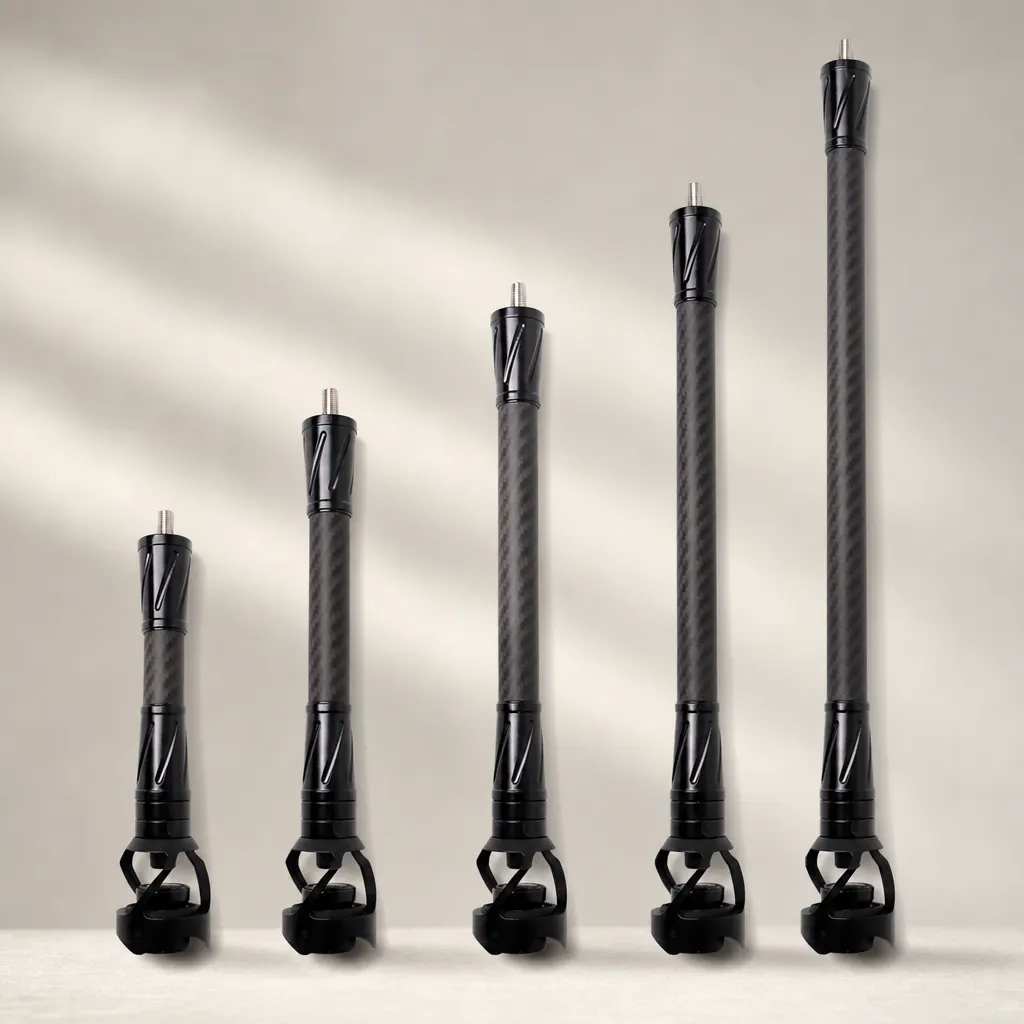
Target archers get to choose their stabilizer in a climate-controlled range. A bowhunter chooses theirs for a November treestand, a pop-up blind with a 20-inch window, and one shot that has to be quiet. Those constraints flip the usual "longer is steadier" logic on its head, and this page explains why — plus what the SteadyDraw carbon bow stabilizer actually weighs and how its built-in damping ball earns its place on a hunting rig. New to stabilizers entirely? The plain-English explainer covers the basics first.
🚨 Only a few left in stock
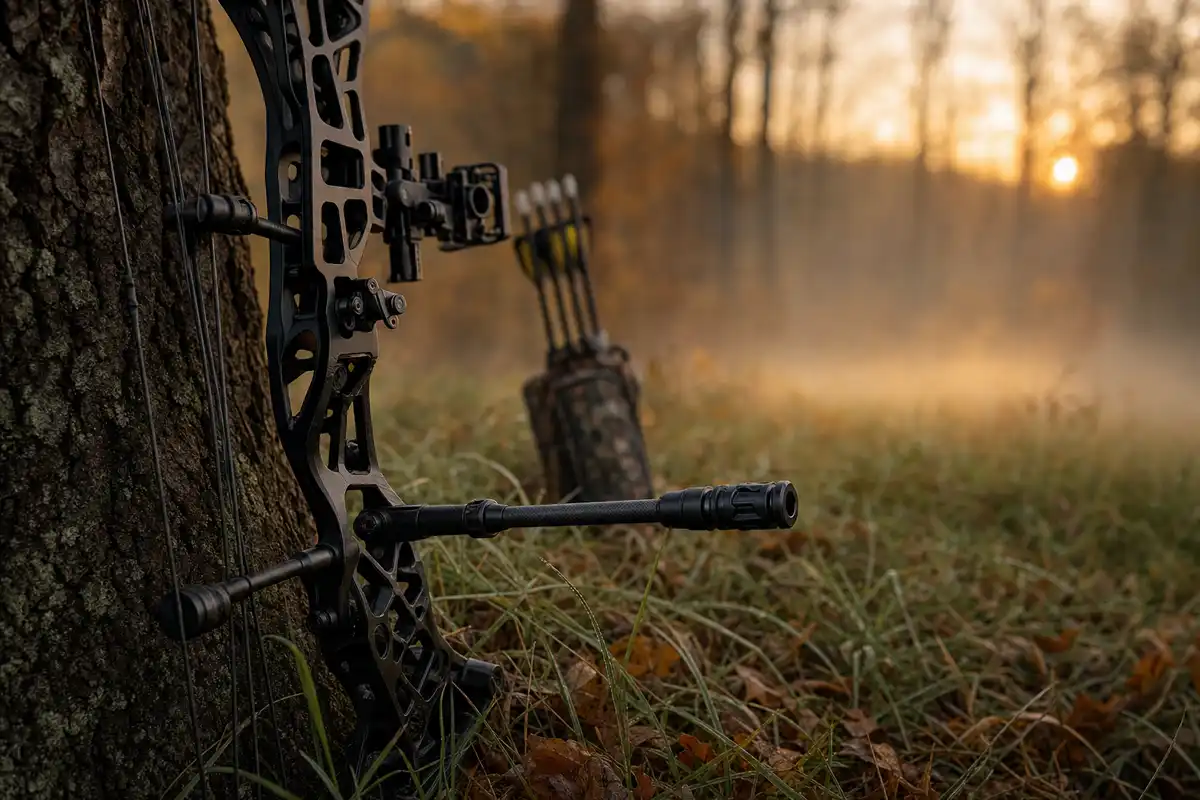
What hunting demands from a stabilizer that target shooting doesn't
Think through where hunting shots actually happen. In a ground blind, you're drawing inside a fabric box and threading the shot through a window — every inch of rod out front is an inch that can bump a shoot-through mesh or rustle a wall. In a treestand, the bow moves constantly: hoisted on a pull rope, hung on a hook, swung across the rail to cover a shooting lane on the weak side. Still-hunting or stalking, the bow rides in your hand through brush for hours, and anything long and snaggy out front announces you. None of that exists on a target line, which is why target-oriented stabilizer roundups are close to useless for choosing hunting gear.
Weather is the quieter constraint. Hunting means rain, frost, and gloved hands, so the materials matter: the SteadyDraw is a 3K carbon rod with a stainless steel counterweight — no components that mind getting wet, and universal screw fittings you can thread in and check snug with cold fingers, no tools needed. It's the same reason carbon took over from older rod materials across the archery industry generally: it shrugs off the conditions a hunting season throws at it.
Why 6–8 inches dominates hunting setups
The physics don't change between disciplines — a longer rod is always steadier, all else equal — but the return on each inch does. A target archer holding for a 50-meter X benefits from every bit of leverage a 15-inch rod provides. A bowhunter holding a pin on a deer-sized target at typical bowhunting distances is working within a far more forgiving margin, and gets most of the stabilizing benefit from the first few inches of properly weighted rod. What the hunter cannot forgive is a bow that won't clear the blind window. That asymmetry — small steadiness gains versus large handling costs — is why nearly every purpose-built hunting stabilizer on the market, from budget rods to the $60–120 US brand names, concentrates its lineup at 6 to 8 inches.
| Hunting situation | Best SteadyDraw pick | Why |
|---|---|---|
| Ground blind, box blind | 6" — $49.95 | Shortest profile of the five; clears windows and mesh without snagging |
| Treestand | 6" or 8" | Compact on the pull rope and hook; 8" adds steadiness for lane shots |
| Still-hunting, thick timber | 6" — $49.95 | Least to catch on brush during hours of carry |
| Open-country spot-and-stalk | 8" or 10" | Longer holds and longer shots reward extra leverage; cover is sparse |
| Off-season 3D and practice | 10"–15" | No clearance limits — see the compound page |
That last row is worth a beat: the SteadyDraw lineup is one stabilizer, five lengths — pick by how you shoot. Some buyers run a 6" all fall and screw a 12" into the same bushing for summer 3D; the screw fitting is a standard universal size, so swapping takes seconds. The length guide covers the crossover cases in more detail.
The damping ball: what it does for shot noise
Here's the sequence at release: the string snaps forward, the arrow leaves, and whatever stored energy didn't go into the arrow has to go somewhere. On a bare bow it goes into the riser, the accessories, and your hand — you hear it as twang and feel it as sting. A damped stabilizer changes where that energy dies. The rod carries it away from your grip, the shock absorbers and the damping ball soak it up, and the result is a shot that sounds duller and feels dead in the hand. For a target archer that's comfort; for a bowhunter it can be the difference between a relaxed animal and one that drops and spins at the sound. We'll stay honest about the limits, as always — see how we test — a stabilizer quiets the bow, it doesn't silence it, and string-borne noise needs its own solutions. But of everything on this page, the damping ball is the feature buyers notice first; the setup guide shows how to remove and reinstall the counterweight it's built into.
Real weights: what 314–347 grams means on your bow
| Length | Weight | Dimensions | Hunting verdict |
|---|---|---|---|
| 6" | 314.2 g / 11.1 oz | 3.9 × 23.9 cm | The blind-and-timber pick |
| 8" | 319.2 g / 11.3 oz | 3.9 × 29.1 cm | The all-around hunting pick |
| 10" | 322.5 g / 11.4 oz | 3.9 × 34.1 cm | Open country only |
| 12" | 330 g / 11.6 oz | 3.9 × 39.2 cm | Off-season 3D, not the woods |
| 15" | 346.7 g / 12.2 oz | 3.9 × 47.2 cm | Range and target work — see the target page |
All figures come from the spec sheet, and slight deviations may occur unit to unit; dimensions are of the full assembly including the counterweight end, which is why the overall length runs past the nominal size. The useful takeaway is how flat the weight curve is: only 5 grams separate the 6" from the 8". You are not choosing between a light stabilizer and a heavy one — you're choosing where roughly eleven ounces of stainless steel counterweight sits. For hunting, closer to the riser wins.
What buyers say after a season
The SteadyDraw has sold 296 units to date and holds a 4.9 rating across its first 52 verified reviews: 51 five-star and one four-star. The themes that repeat are the ones hunters care about: solid packaging and finish ("everything arrived intact, great stabilizer, well packaged," per a verified buyer review) and price versus what's available locally ("good quality product, not as expensive as in Polish stores," per a Polish verified buyer). At $49.95 for the 6" and $52.95 for the 8", it sits deliberately between the $25–45 generics and the $60–120 US target brands — the full reviews are on the reviews page, and every order ships free in the US with a 30-day money-back guarantee.
Average monthly US searches for 'hunting bow stabilizer'
— DataForSEO keyword data, 2026
Weight of the 6-inch SteadyDraw — the lightest of the five lengths
— SteadyDraw spec sheet, 2026
Average rating across 52 verified SteadyDraw buyer reviews, 296 sold
— SteadyDraw verified buyer data, 2026
free shipping to 18 countries · 30-day money-back guarantee

Wade Corrigan · Bowhunter & 3D archer, 9 yrs
Wade has spent nine years hunting and shooting 3D courses — much of it from treestands and ground blinds.
See how we test for the criteria behind every claim on this page.
Hunting bow stabilizer FAQ
Is a 6-inch stabilizer enough for a hunting bow?
For most bowhunting, yes. Hunting shots are close-range and taken from a rested, deliberate position, so you need enough mass out front to settle the pin and kill vibration — not the full leverage a target line rewards. The 6-inch SteadyDraw puts 314.2 g on the front of the riser, which steadies the hold noticeably while staying short enough for any blind window.
Does a bow stabilizer make your bow quieter?
It reduces the after-shot noise, yes. Much of the twang and buzz you hear at release is the riser and accessories ringing with leftover energy. A stabilizer with dampers gives that energy somewhere to die: the SteadyDraw combines shock absorbers with a built-in weight damping ball, so less of the leftover energy rings out as sound. It will not make a bow silent — nothing does — but the shot is audibly duller.
How much does a SteadyDraw hunting stabilizer weigh?
The two hunting lengths weigh 314.2 g (11.1 oz) for the 6-inch and 319.2 g (11.3 oz) for the 8-inch — slight deviations may occur between units. That is roughly the weight of a full water bottle spread along the front of your riser, enough to matter at full draw without making the bow tiring to carry all day.
Can I remove the damping ball for hunting?
Yes — the built-in weight damping ball is part of the counterweight piece, and that whole piece is detachable by design. Most hunters leave it on, since noise reduction matters more in the woods than anywhere else. But if you want the shortest, snag-free profile for a cramped ground blind, or you simply prefer the feel of the bare rod, it unscrews and reinstalls in seconds without tools.
Related pages
Compare all five lengths on the bow stabilizer homepage, dig into compound-specific balance on the compound bow stabilizer page, or read the setup guide before opening weekend. Wondering whether you need one at all? Start with what a bow stabilizer does.