· Wade Corrigan
The Best Bow Stabilizer in 2026: A Three-Tier Guide
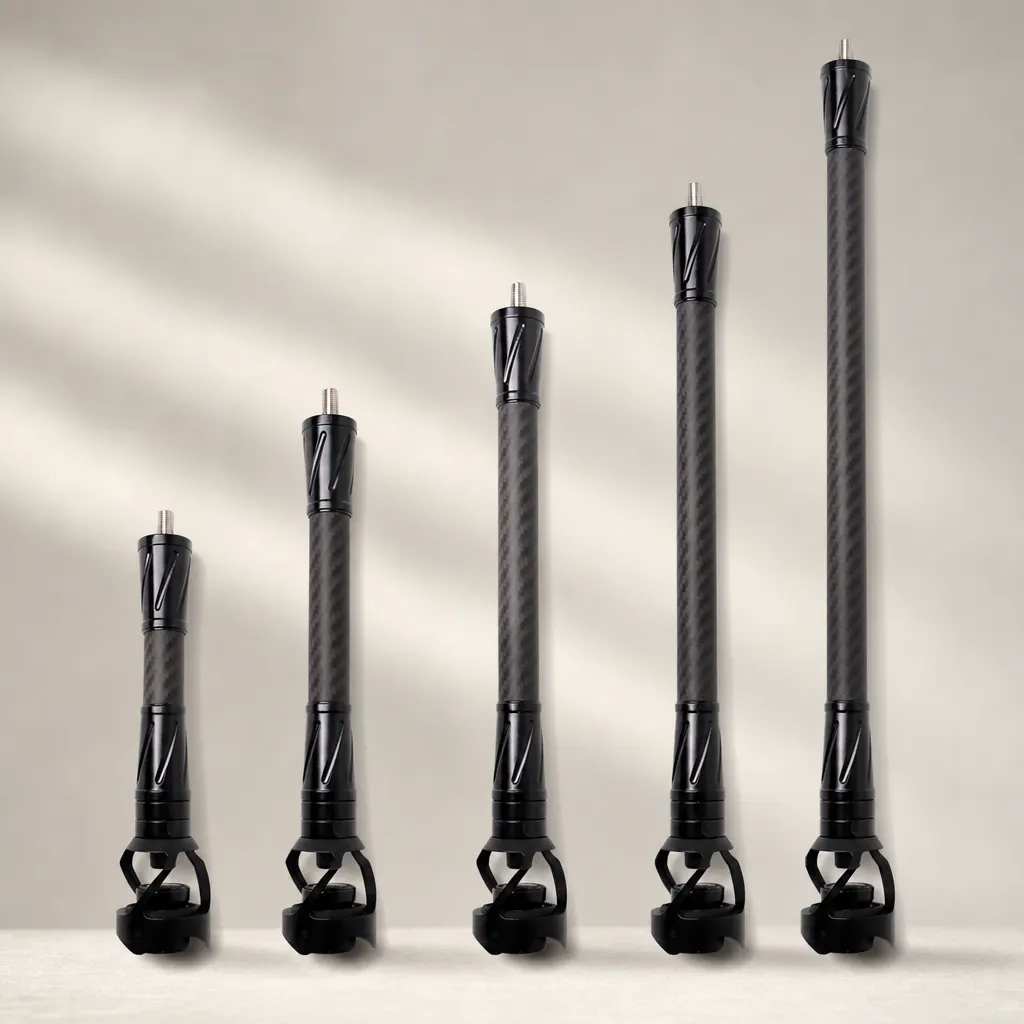
Full disclosure before anything else: we sell the SteadyDraw stabilizer, and this guide lives on our own website — judge our bias accordingly. To keep this useful anyway, every claim about our own rod is limited to the spec sheet or what verified buyers wrote: 3K carbon, a stainless counterweight, five lengths, weights to the tenth of a gram. If that transparency reads strangely, our how we test page explains why we work this way.
US monthly searches for "best bow stabilizer" — most of them landing on roundups that never disclose who sells what
— DataForSEO keyword data, US, 2026
The market in three tiers
Strip away the branding and almost every front stabilizer is the same machine: a stiff rod, a weight at the tip, a damping element in between, and a threaded stud that screws into the riser's front bushing. What changes between $25 and $120 is not the physics — it's material quality, consistency from unit to unit, and what happens when something goes wrong. That's why tiers are a more way to shop than any ranked top-ten list, including this one.
| Tier | Price | What you're paying for | The trade-off |
|---|---|---|---|
| Premium tier | $60–120 | Established US brands, wide dealer networks, proven consistency, resale value | You pay a brand premium for performance a good mid-range rod largely matches |
| Mid-range (SteadyDraw and peers) | $40–60 | Carbon construction and real damping at a direct-to-consumer price | Younger brands, no pro-shop network, smaller review history |
| Budget generics | $25–45 | The lowest possible entry price | Quality control is a lottery; specs are often copy-pasted between listings |
Premium tier ($60–120): what the extra $50 buys
We're not going to invent lab numbers about other brands' rods, so here is the qualitative picture: this tier is everywhere in US archery, from 3D courses to hunting camps, and its advantages are handling a rod at a local shop, warranty through a dealer network, and a used market that knows what the gear is worth.
The measurable question is whether a $100 rod steadies your particular bow meaningfully better than a $50 rod built from comparable materials. For sponsored competitors chasing every last point, the modular tuning range is what they use it for. For most hunters and club shooters, the physics — inertia, leverage and damping — doesn't read the logo.
Mid-range ($40–60): where the SteadyDraw sits
This is our tier, so hold us to specifics. The SteadyDraw stabilizer is a 3K carbon fiber rod with one detachable tip piece: a stainless steel counterweight that's also the built-in weight damping ball. It comes in five lengths — 6", 8", 10", 12" and 15" — weighing from 314.2 g to 346.7 g, with slight deviations possible between units. The screw fitting is a standard, universal size that threads into any modern riser's accessory bushing. Shipping is free in the US, and there's a 30-day money-back guarantee, which matters more from a young brand than from an established one: it's the substitute for handling the rod in a shop first.
The limits, stated plainly. SteadyDraw is a recent brand sold direct, not through pro shops, so the 30-day money-back window is what stands in for handling the rod on a shop counter — ship it back at our cost if the balance isn't what you wanted. Our review history is short: a perfect average, but across dozens of buyers, not thousands. And we sell one design in five lengths rather than a modular system with interchangeable weight stacks.
Average across all 52 verified buyer reviews to date: 51 buyers left five stars and one left four
— SteadyDraw verified buyer reviews, 2026
What the early buyers actually praise is telling: packaging, finish and value. A buyer in Poland put it simply: "fast delivery, well protected, good quality product, not as expensive as in Polish stores" — a real, local data point, not a lab claim. The photos and full verbatims are on our reviews page, including the terse ones.
SteadyDraw stabilizers sold to date across the five lengths — a counted figure, not a rounded-up claim
— SteadyDraw sales data, 2026
Budget generics ($25–45): the quality lottery
The generic tier is where the same product photo appears under six brand names at four prices. Some of those rods are fine. The problems, when they come, are predictable: tip weights that don't match the listing, rods that are aluminum painted to look like carbon weave, damping rubber so hard it damps nothing, and threads cut loosely enough to work themselves free during a session. There's no way to know which listing you're getting until it arrives, and usually no meaningful return path when it disappoints.
Added mass out front is added mass out front, whatever it costs. What $49.95 adds over the generic tier is a spec sheet you can hold us to: 3K carbon, a stainless counterweight, a listed weight per length, and a standard thread that seats square in the bushing instead of working itself loose during a session.
Verdict: which SteadyDraw length matches your shooting
| You are… | The length to fit | Why |
|---|---|---|
| A bowhunter who wants a quiet, compact rig | 6–8" | Short rods clear branches and blind windows while still moving the balance point forward. See the hunting bow stabilizer guide. |
| A compound shooter building a first serious setup | 10" | The all-around length at $52.95, and it leaves budget for arrows. Full reasoning on the compound bow stabilizer page. |
| A recurve or target archer chasing hold stability | 12–15" | Long rods reward stiffness, and 3K carbon delivers it at 346.7 g in the 15". Compare on the recurve bow stabilizer page. |
| A competitor who re-balances ounce by ounce between seasons | 12–15", plus the detachable counterweight | The stainless tip piece comes off, so the rod can be run bare or weighted. Modular ounce-stack kits are the premium tier's own specialty. |
| A casual backyard shooter | 6–10" | Any front mass helps; these two lengths are the easiest to live with on a light bow. |
Whatever you buy: length first, brand second
The most common stabilizer mistake isn't overpaying — it's fitting the wrong length for how you actually shoot, in every tier. A 15" bar in a ground blind and a 6" stub on a target line are both the wrong tool with the right logo. The bow stabilizer length guide sizes it in two minutes, and the stabilizer setup guide balances the rod once it arrives. For the mechanics themselves, see what a bow stabilizer actually does.
If the mid-range argument convinced you, ours ships free in the US with 30 days to change your mind — the length selector and each size's checkout are on the homepage.

Wade Corrigan · Bowhunter & 3D archer, 9 yrs
Wade has spent nine years hunting and shooting 3D courses.
Written by Wade Corrigan · See our testing methodology.