· Wade Corrigan
Bow Stabilizer Thread Size: 5/16-24, Adapters and Mounting Holes
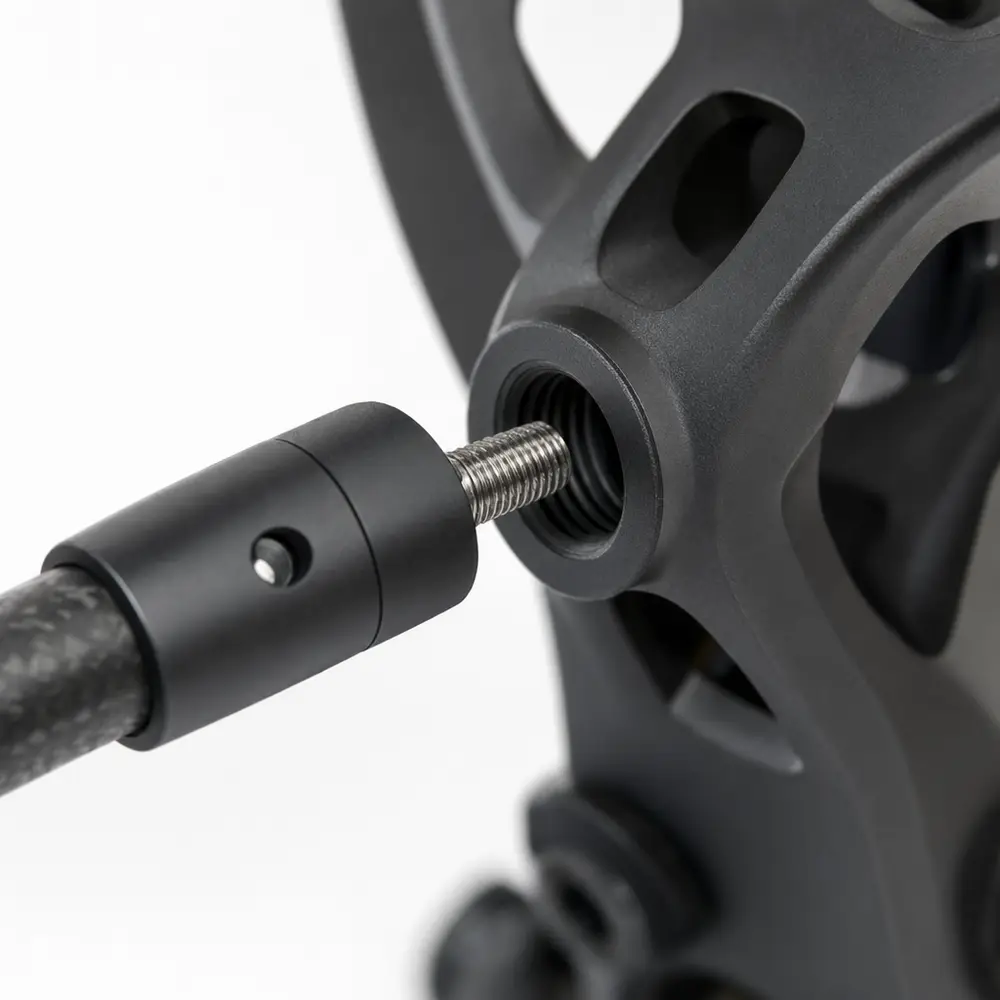
People ask this at the moment it matters: a bar has arrived, the bow is on the bench, and nobody wants to find out the hard way that the stud does not match the hole. The answer itself is short. The useful part is everything around it, because thread size is where a few hundred dollars of riser gets ruined by ten seconds of impatience. For mounting and balance rather than hardware, the stabilizer setup guide takes it from there.
the thread archery suppliers list for stabilizers, rests, quivers and sights, per the maker of a repair tool cut for it
What thread size is a bow stabilizer?
Fine pitch is not decorative. It puts more metal in contact for the same depth of engagement, which matters on a part that gets shock-loaded every shot, and it means the stud travels a long way for the amount of turning you do. The moment you feel resistance and think that must be tight arrives well before the bar is seated. Two independent suppliers cut hardware to the same number: 3Rivers Archery describes its front stabilizer insert as featuring an "industry-standard 5/16"-24 thread", and Pine Ridge Archery makes a repair tool in that size for "stabilizers, rests, quivers, sights, and other bow accessories".
How do you check what your own riser takes?
Start the stud square to the hole and turn it counterclockwise half a turn first. You will feel a small click as the thread start drops into place, and from there it threads in clockwise without resistance. Learn that habit, because cross-threading is what actually destroys bushings, fine threads cross-thread quietly, and a cross-threaded stud keeps turning for a while before it jams.
Do not assume from the brand. Fitment on a specific bow is a manufacturer question, and risers differ in how many accessory holes they carry. Our compound and recurve and target pages cover which lengths suit each setup, but for the hole itself your bow's own documentation outranks any guide, this one included.
The other threads on your bow, and what mixing them up costs
| Thread | Where it turns up | Why you care |
|---|---|---|
| 5/16-24 UNF | Front stabilizer bushing, plunger buttons | The one your bar uses |
| 1/4-20 UNC | Weight ends on some stabilizer brands | Why adapter screws exist |
| 10-32 | Compound sight pins and scopes | Close enough in size to tempt a wrong guess |
| 8-32 | Recurve sight pins and scopes | Never a stabilizer thread |
| 6-32 | Most clicker connections | Smallest of the set |
Thread sizes as published in the Archery Webshop trade reference. Applications vary by manufacturer.
Similar sizes are the dangerous ones. Nobody puts a clicker screw in a stabilizer hole. Plenty of people have started a sight screw into something it was never meant for, felt it bite, and kept going. If a fastener does not turn in sweetly with two fingers, it is the wrong fastener or it is crooked, and the answer is never more torque.
When do you actually need a thread adapter?
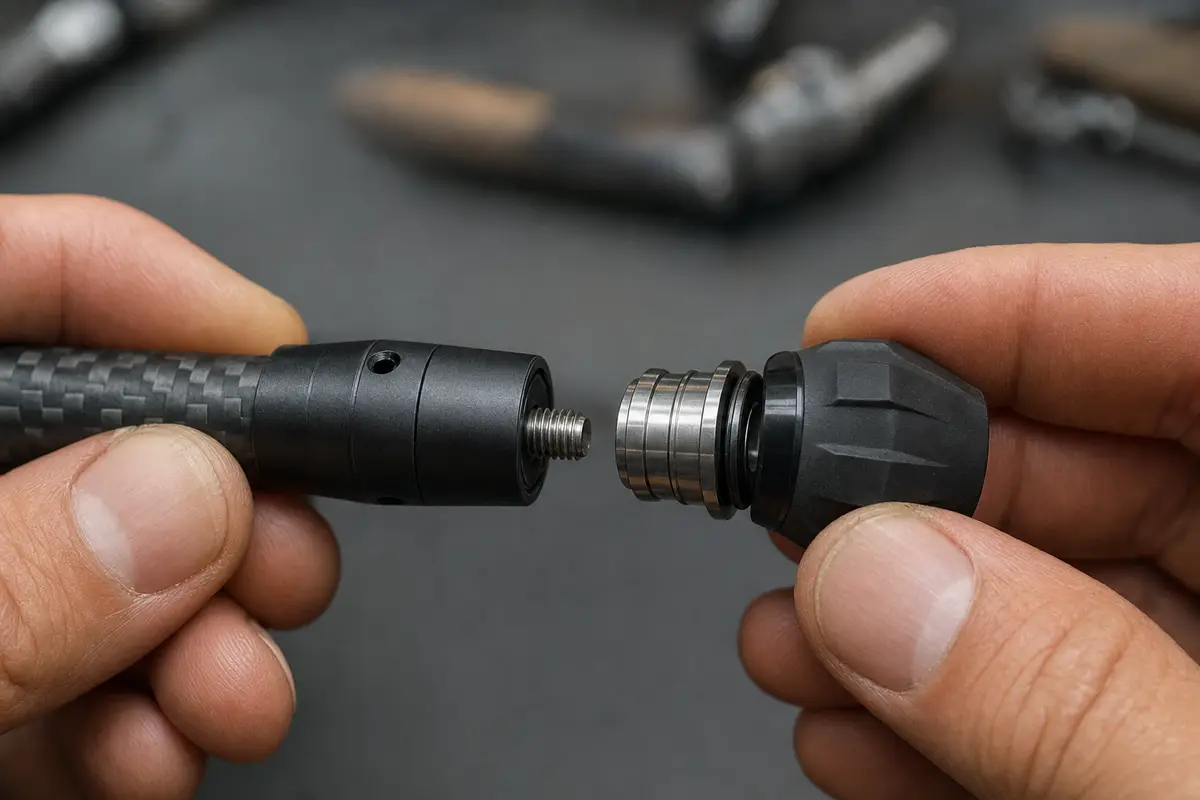
The photo above shows why this end is where the confusion lives. The tip of a stabilizer carries its own male thread, the counterweight screws onto it, and nothing says it has to match the thread going into your riser. Buy weights from one brand and a rod from another and you can end up one small screw short of a working setup.
Two cautions before ordering one. An adapter turns a single threaded joint into two, and every joint is somewhere a heavy piece of steel can work loose under repeated shock, so check both ends after your first session. And an adapter is for a confirmed mismatch, never a workaround for a stud that will not seat in your riser.
the second thread size the archery trade reference lists for stabilizers alongside 5/16-24 UNF, and the reason adapter screws are sold at all
Which bows have no 5/16-24 stabilizer hole?
The traditional case is the common one. No bushing means nothing for any stabilizer to thread into, and no adapter changes that. Threaded front stabilizer inserts are sold for exactly this situation, and the installation spec is a fair warning about what it involves: 3Rivers Archery calls for a 29/64 inch bit taken to a depth of 9/16 inch, set with epoxy, drill press recommended. That is a hole through the working part of a bow, so take it to a bowyer or a pro shop.
The integrated case is newer and easier to get wrong at checkout. If your riser is built around a proprietary slot, a bar cut with a standard stud may have nowhere obvious to go, or it may go into a conventional bushing that also exists on the same riser. Check the bow, not the internet.
drill depth specified for fitting a threaded stabilizer insert into a riser that has none, using a 29/64 inch bit and epoxy
— 3Rivers Archery front stabilizer insert installation spec, 2026
The second and third mounting holes on a riser
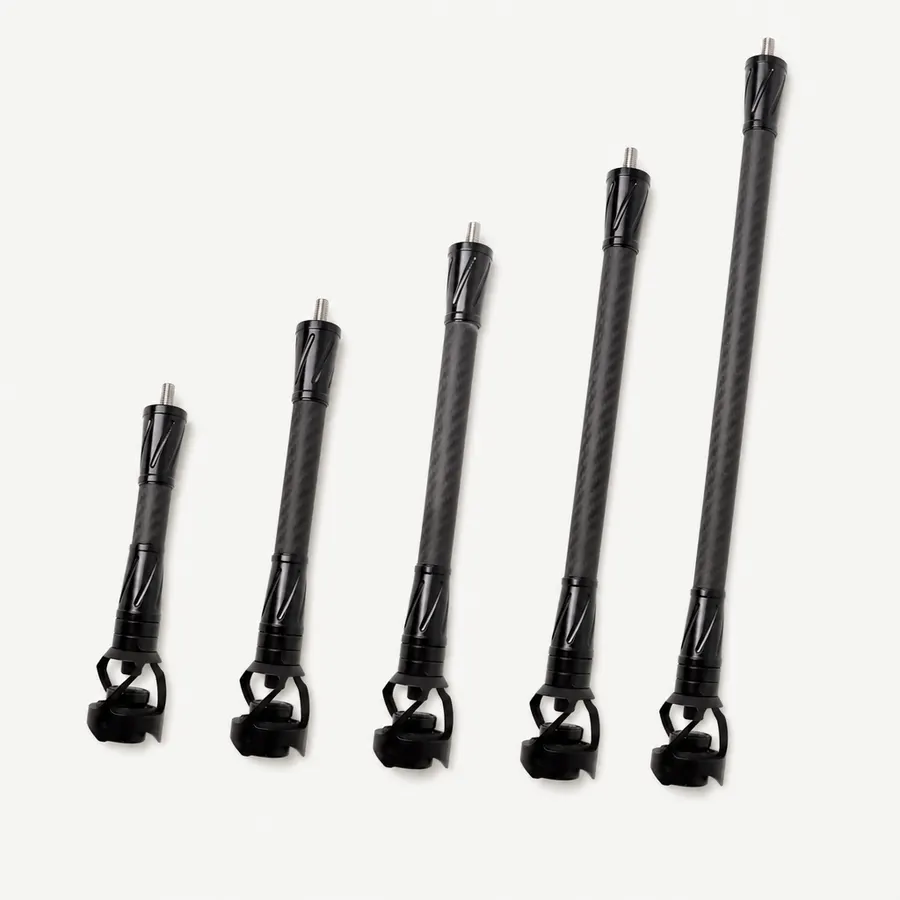
Knowing the second hole exists saves you from one specific mistake: seeing an unused threaded hole and deciding it must be where the stabilizer goes. The front bushing sits on the front face of the riser, below the grip, pointing at the target. Anything pointing back at you is a rear position, and a front bar mounted there does the opposite of what you bought it for. Straight about our own product: the SteadyDraw carbon bow stabilizer is a front bar, sold one piece per order.
How tight, how threads fail, and what we will not claim
The threads you are protecting usually belong to a separate bushing set into the riser, not to the riser casting. BPE Manufacturing lists one as "5/16"-24 Thread, 7/16 O.D. shank", and Mathews sells a riser bushing for its Switchweight bows described as "7/16-20 thread", which is the size going into the bow rather than the size your bar uses. That small part does all the holding, which is why it fails first. Pine Ridge Archery sells a 5/16-24 repair tool for debris and minor damage, but no tool rebuilds a bushing that has given up. If a stabilizer keeps backing out while you shoot, stop, take the bar off and have the bushing looked at rather than cranking harder. Never draw on anything you do not intend to shoot, and never release a drawn string without an arrow.
Now the part most stores skip. The manufacturer's specification for our bar says "universal screw fittings will fit all modern risers", and that is the claim we hold it to, exactly as set out on our how we test page. No thread dimension for this stabilizer has ever been published, so we do not print one, even in an article named after thread sizes. Buyer feedback fits the claim so far: the marketplace tag cluster includes "fits well" with two mentions, and one buyer in Belarus wrote, "Thank you to the seller for the fast delivery and quality product! Everything fully matches the description!" The rest, least glowing included, sits on the reviews page. If the next question is which bar to buy, the length guide is the decision that changes how your bow feels, and what a stabilizer does covers why any of it works.
Bow stabilizer thread FAQ
Are all bow stabilizers the same thread size?
On the bow end, near enough. The trade converged on 5/16-24 for the front stabilizer bushing, and that is the thread archery suppliers list for stabilizers, rests, quivers and sights. Variation shows up elsewhere: at the weight end of the bar, and on integrated slot mounts that use no stabilizer stud at all.
My weight is 1/4-20 and my stabilizer is 5/16-24. What now?
You need an adapter screw, not force. Avalon sells one described as a "threaded adapter for stabilizers and weights" that "converts thread sizes from 1/4"-20 to 5/16"-24 or vice versa". Fit it, then check both ends for snugness after your first session, because an adapter turns one joint into two.
How do I know if my riser threads are stripped?
The stud turns easily but never gets tight, or it goes in crooked and binds after a turn or two. Stop there. A thread repair tool in 5/16-24 exists for debris and minor damage, but a bushing that will no longer hold is a pro-shop job, not a garage one.

Wade Corrigan · Bowhunter & archery gear tester, 9 yrs
Wade has spent nine years hunting and shooting 3D courses, testing stabilizers, sights and release aids for real-world balance, vibration and noise, not spec-sheet promises.
Written by Wade Corrigan · See our testing methodology.
Free US shipping, typically 8 to 10 business days · 30-day money-back guarantee