· Wade Corrigan
What Is a Bow Stabilizer Made Of? Carbon, Steel and the Part That Absorbs the Shot
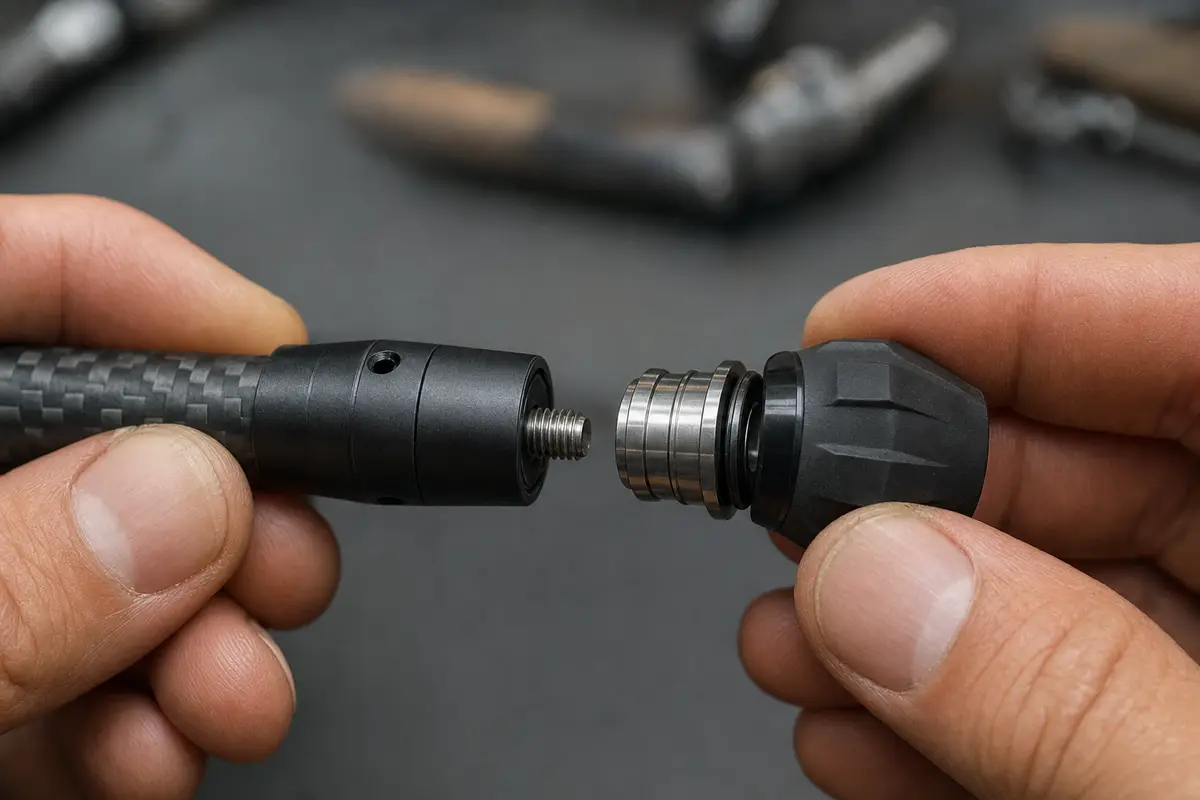
Take a front bar apart and it stops looking like an accessory and starts looking like an assembly. There is a tube, there is a lump of metal, and there is something soft holding them apart. Each part is a different material because each has a different job, and once you can name the three jobs, most of the language around bow stabilizers becomes easy to read. This guide takes the materials one at a time.
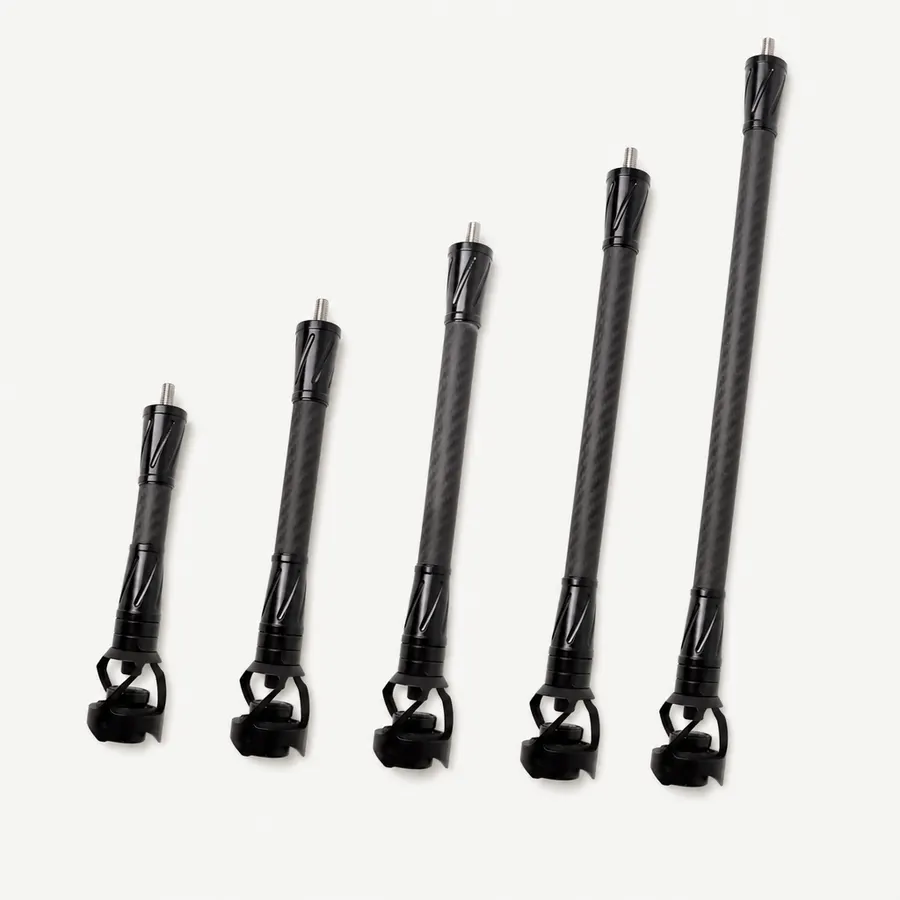
the entire weight spread between the 6-inch and 15-inch SteadyDraw — nine extra inches of carbon rod, and almost no extra mass, because the mass lives in the steel
— SteadyDraw spec sheet, 2026
Three materials, three jobs
Start from what the bar has to achieve. Mass held far from the riser gives the bow rotational inertia, so your sight pin drifts more slowly — the mechanics are covered in full in what a bow stabilizer does. But the leverage only works if the mass stays put. A rod that bends under its own tip weight lets the mass swing instead of holding it, and a swinging weight is a pendulum, not a stabilizer.
So the rod wants maximum stiffness for minimum weight. The counterweight wants the opposite: maximum weight in minimum space, right at the tip where leverage multiplies it. The connection between them wants to be neither — soft enough to flex, lossy enough to turn vibration into heat rather than pass it down the bar into your hand. Ask one material to do two of those jobs and it does both badly.
The rod: what "3K carbon" actually describes
The number gets quoted as though it were a performance figure. It is not: it describes the cloth. A larger tow number means a coarser weave with bigger visible squares, a smaller one a finer pattern. 3K sits in the middle and has become the default across archery tubing, which is why so many rods look alike under the clear coat.
What carbon brings is stiffness per unit of weight. A stabilizer rod is a cantilever — anchored at one end, carrying a load at the other — which is the loading case that punishes flexible materials hardest. Carbon laid up as a tube resists that bending extremely well for its mass, and without the ringing a thin metal tube produces when struck. Our rod is 3K carbon with the weave visible along its length, in five lengths from 6 to 15 inches; the length guide covers which suits which kind of shooting.
Carbon or aluminum: what changes on the bow
This is the practical difference, and it is easy to miss because both rods weigh something. What matters is where the grams are. Weight at the tip buys inertia; weight spread along the rod buys very little of it and costs the same effort to hold up at full draw. A bar that is heavy in the wrong place tires your bow arm without steadying the pin much.
Metal tubes also have an acoustic habit: struck sharply, they ring. Carbon is a comparatively dead material, so it absorbs more of the shot's high-frequency energy instead of re-radiating it as noise. For a target archer that is a footnote. For a bowhunter it is not, which is why carbon dominates hunting stabilizer setups where a quiet release is part of the point.
The counterweight: why stainless steel
Density is why counterweights are not made from aluminum: one matching a steel weight would be several times the volume, turning a compact tip into a club. Lead is denser still, but it is soft, it deforms, and it brings handling issues nobody wants on kit they hold every day. Stainless lands in the useful middle — dense, hard, machinable into clean threads, corrosion-resistant.
That last property earns its keep across a season. The counterweight is the most exposed part of the assembly: the furthest point from you, and the part that sits in the rain. Plain steel would show rust at the machined faces first, exactly where threads need to stay clean. On our bar the counterweight is stainless and detaches as one piece, which is also the piece you handle when tuning balance — the setup guide covers how to read the balance before you touch it.
the weight range across all five SteadyDraw lengths with the stainless counterweight fitted — the same tuning system on every bar
— SteadyDraw spec sheet, 2026
The damper: the soft part doing the quiet work
Rubber does this because it is viscoelastic. Push it and it deforms; release it and it returns, but not all the energy comes back — some is lost internally as heat. That loss is the entire point. A rigid connection between rod and weight would transmit vibration almost perfectly; the soft element deliberately makes it a bad transmitter.
It is also the part where quality varies most and shows least. Damping rubber mixed hard, or aged and stiffened, looks identical to good rubber but behaves like a solid spacer. You cannot tell by eye; you can sometimes tell by thumb, since a damper that gives under firm pressure and springs back is doing something. On our bar the damping ball is part of the same detachable end piece as the counterweight, so the soft element and the mass come off together.
What a season of weather does to each material
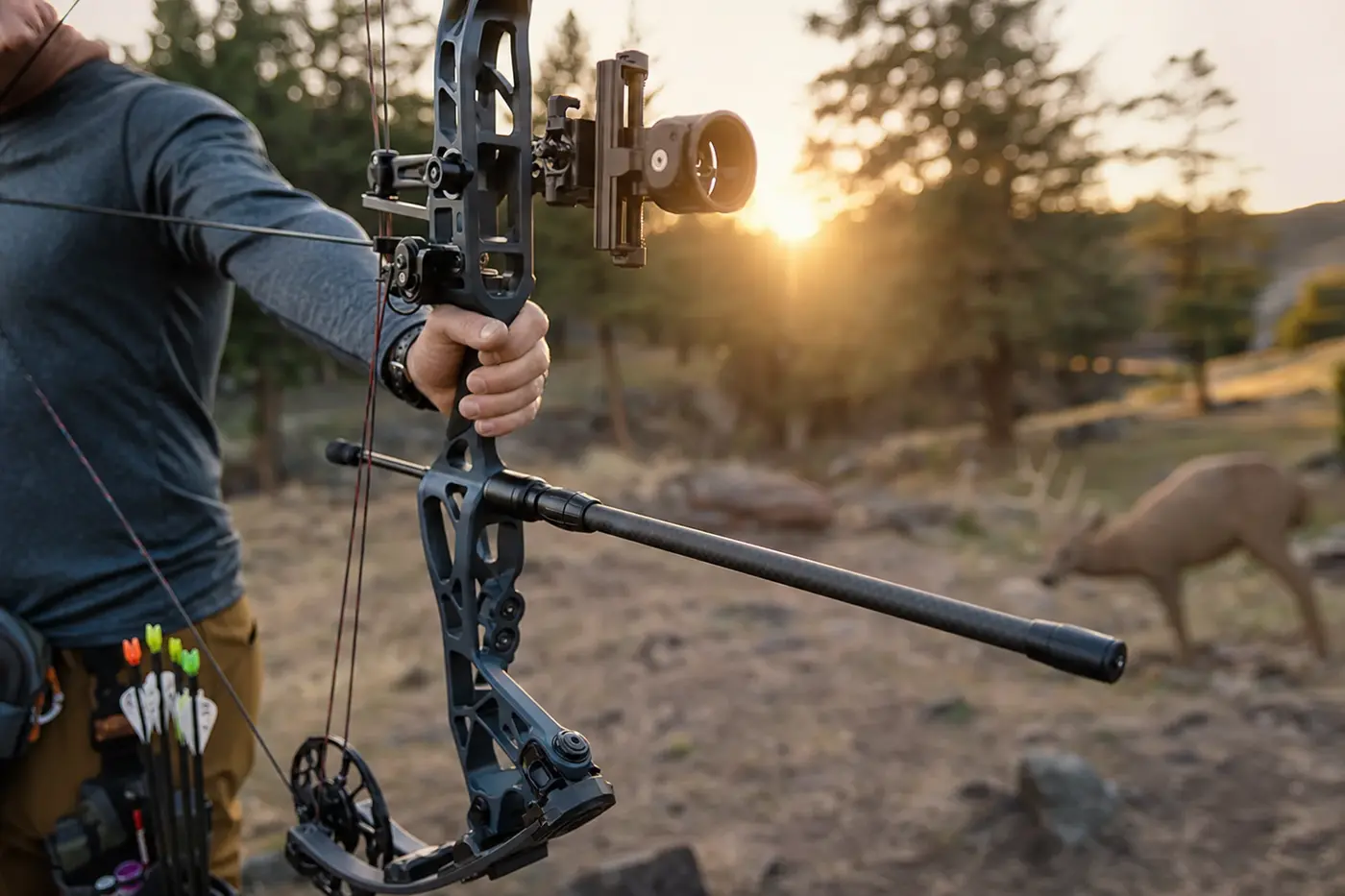
Materials get judged on a bench and used in a field, and the three behave differently once the temperature drops. Carbon fiber is essentially indifferent to water and barely moves dimensionally with temperature, which is why it took over from older rod materials across archery generally. Stainless steel is likewise unbothered by rain and frost. Rubber is the one that notices: elastomers stiffen in the cold, so a damper is a slightly firmer damper on a frozen morning than in August.
It is a small shift, it affects every rubber-damped bar equally, and the balance you tuned does not move.
The joints deserve more attention than the materials do: vibration is what works a threaded connection loose over a season, not the metal itself. The fittings are a universal screw size you can check by hand without tools, and the thread guide explains where the two different threads on a stabilizer live.
Reading a rod with your hands
Three checks take about ten seconds each. Rotate the rod under a light and watch the weave, since real cloth has a subtle three-dimensional shimmer and a film does not. Look at the cut ends, where a genuine tube shows the laminate in section while a wrapped metal tube shows metal. And weigh it in your palm — a carbon bar feels tip-heavy, because the steel is at the end, which is exactly the distribution you are paying for.
The same logic applies to the counterweight: stainless is hard enough that machined ridges stay sharp, while softer plated metal rounds off and shows brassy colour where it wears. None of it requires tools. For the wider view by price band, our three-tier breakdown sets out what changes between them.
average rating across all 52 verified SteadyDraw buyer reviews to date, 296 units sold — 51 five-star and one four-star, shown as they stand
— SteadyDraw verified buyer data, 2026
Which material figures actually mean something
Stabilizer listings routinely quote modulus values, wall thicknesses and alloy grades. Those numbers travel from one product page to the next without anyone re-measuring them, and a figure repeated from a spec sheet carries exactly as much authority as the sheet it came from. What matters on this bar is weight and where it sits.
That leaves something concrete to work with. Every length has a listed weight, the spread between the shortest and longest bar is 32.5 grams, and the materials are stated plainly — a 3K carbon rod, a stainless steel counterweight, a rubber damping element, universal screw fittings. The reviews page shows the bar in buyers' own photos rather than in studio lighting.
Bow stabilizer material FAQ
What are bow stabilizers made of?
Three materials, each with a separate job. The rod is carbon fiber on most bars above the bargain shelf, because it holds mass out in front of the riser without flexing and without weighing much itself. The counterweight is metal, usually stainless steel, and supplies nearly all the mass. Between them sits a rubber damping element that absorbs vibration at the shot.
Is a carbon bow stabilizer better than an aluminum one?
For the rod, carbon does the structural job better at the same mass, which is why it became the standard above the cheapest tier. The rod has to hold a weight at arm's length without flexing, and stiffness per unit of weight is exactly what carbon offers. Aluminum works, but you either accept some flex or add metal to stop it.
Why is the counterweight steel instead of aluminum?
Because it has the opposite job to the rod. You want its mass concentrated in the smallest possible package at the tip, so density is the useful property, and steel is far denser than aluminum. A stainless counterweight also shrugs off rain and frost, on a part that sits exposed at the end of the bar all season.

Wade Corrigan · Bowhunter & 3D archer, 9 yrs
Wade has spent nine years hunting and shooting 3D courses.
Written by Wade Corrigan · See our testing methodology.
Free shipping, typically 6 to 10 business days · 30-day money-back guarantee