· Wade Corrigan
Bow Stabilizer vs Limb Dampeners vs String Silencers: What Each One Actually Quiets
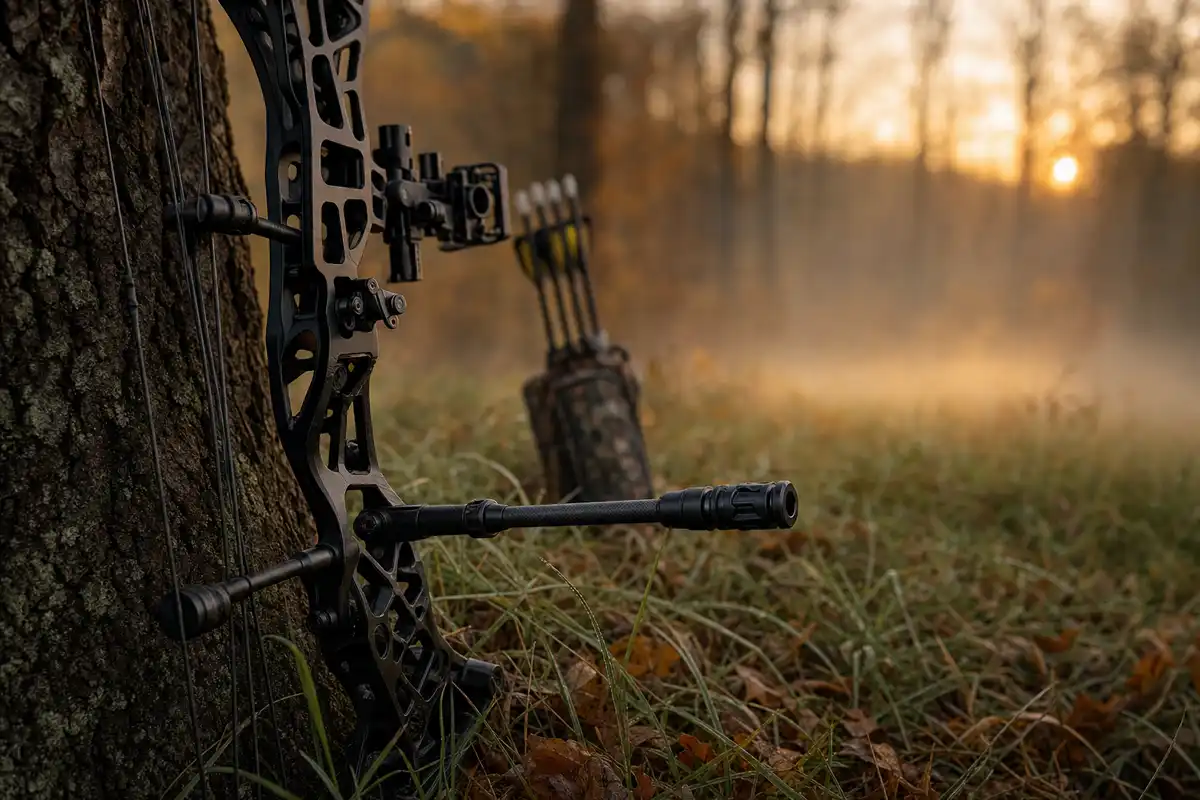
Three accessories promise a quieter bow: a front rod with a weight on the end, a pair of soft pucks for the limbs, and a set of silencers for the string. The packaging uses the same words for all three — vibration, noise, dampening — but they are not three versions of one thing. Each sits on a different part of the bow and works on a different part of the instant after release. This guide takes them one at a time: what each quiets, what it does to balance, and how they stack. The bow stabilizer gets the most space, because it is the only one that does anything before the shot.
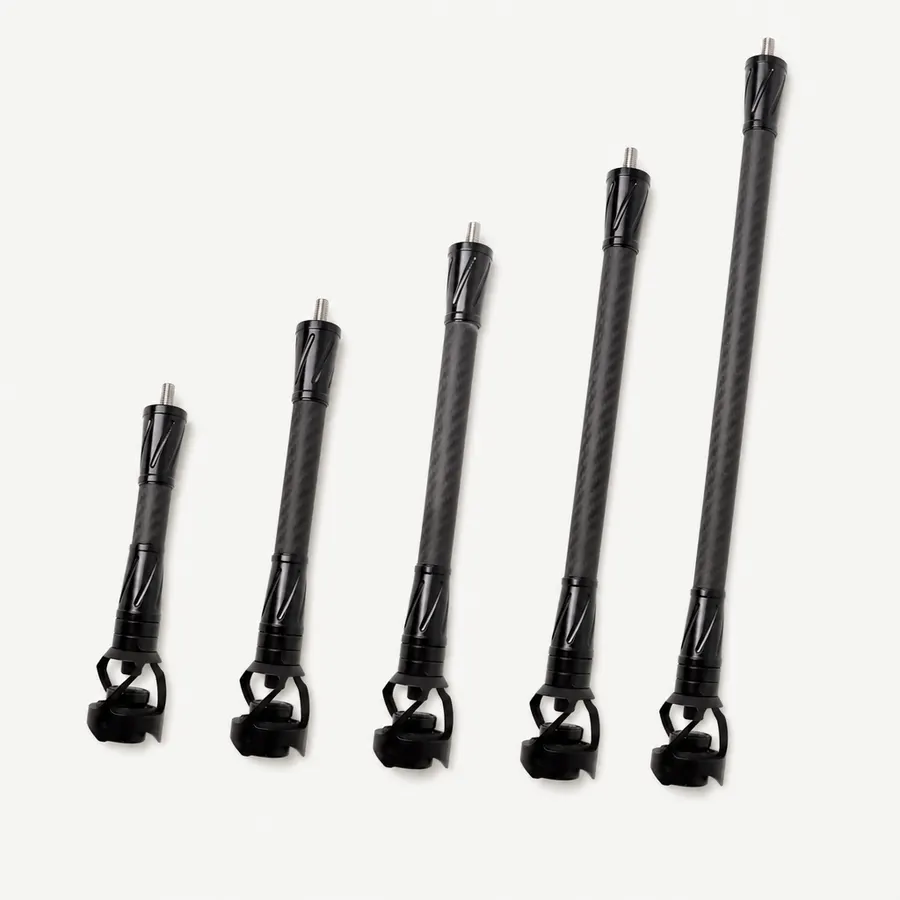
the mass the 6-inch SteadyDraw puts in front of the riser — neither of the other two accessories adds anything close, which is why only the stabilizer changes the hold
— SteadyDraw spec sheet, 2026
Three accessories, three places the energy goes
Run the shot in slow motion. The string drives the arrow forward, the arrow leaves, and the string keeps going: it overshoots brace height, snaps back and rings on its own. The limbs, suddenly unloaded, stop at the end of their travel and shudder. And the riser, bolted to the limbs and held in your hand, carries whatever reaches it into your grip. You hear the first two and feel the third.
One accessory cannot cover all three, and the reason is geometry: soft mass on the string can only act on the string, a puck on a limb only on that limb, and a weighted rod on the front of the riser acts on the riser and on the hand holding it. So the useful question is not which accessory quiets a bow — it is which part of the bow you are trying to quiet.
What a bow stabilizer quiets, and what it changes before the shot
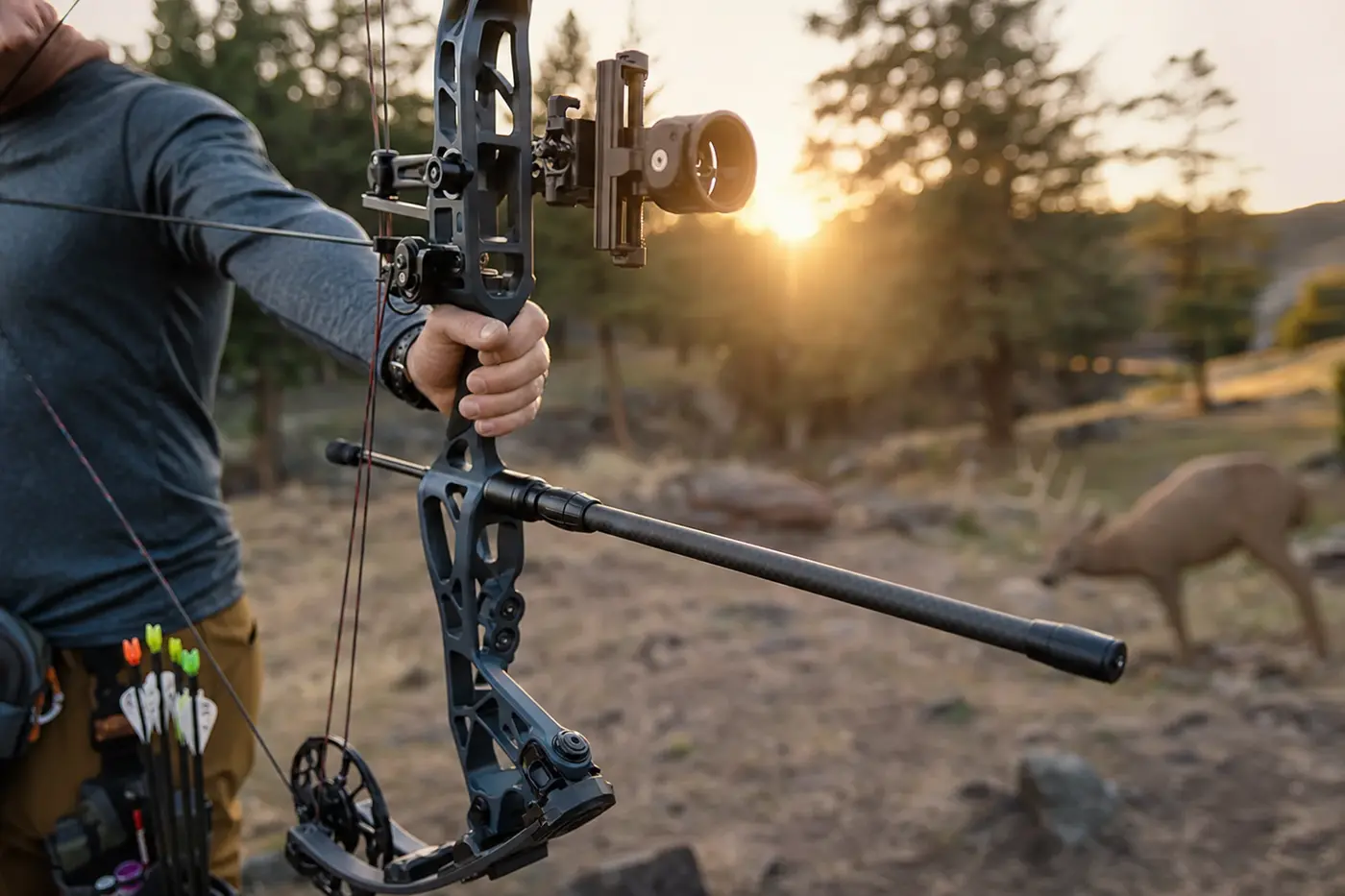
Before the release, the stabilizer is a lever. Mass held out on the end of a rod gives the bow rotational inertia, so the small movements your muscles make at full draw rotate it more slowly and over a smaller arc — the pin drifts instead of darting. The same mass shifts the balance point forward, so a riser loaded with a sight, a rest and a quiver sits level instead of tipping toward its top limb. The mechanics are in what a bow stabilizer does; the point here is that nothing a limb dampener or a string silencer does happens before the string is released. This is the stabilizer's territory alone.
After the release, the stabilizer changes where the leftover energy dies. The rod carries part of the shock away from the grip, and the soft element between rod and counterweight — on the SteadyDraw, a built-in weight damping ball in the detachable stainless end piece — turns some of that motion into heat instead of letting it ring back through the riser into your hand. The shot feels deader and sounds duller. The materials guide covers the damper inside the stabilizer, the rubber component itself; this guide is about three separate accessories, and the two are easy to confuse because both use the word damper.
What the stabilizer leaves alone is the string: its oscillation happens away from the riser, and no mass on the front bushing reaches it. A stabilizer quiets the bow without silencing it, and the twang is a separate job for a separate accessory.
What limb dampeners do
A bow limb is a spring, and a spring that is suddenly unloaded does not simply stop: it overshoots and oscillates until the energy is used up. A limb dampener is a lossy mass on the limb — rubber or a similar elastomer, the same family of material as the stabilizer's own damper — and because it is soft, it lags behind the limb's motion and soaks up some of the energy on each swing. You notice it in the feel first, then in the sound, since part of the limb's shudder was the buzz you were hearing.
What limb dampeners do not do is anything before the shot. They add no leverage, so the pin floats exactly as it did without them. Their mass is small and fitted as a matched pair, one per limb, so the balance at full draw is not what they change either: a bow with limb dampeners and no stabilizer still tips toward its loaded side and still floats, it just shudders less on the way out. Mount them where the maker says and leave them: there is nothing to tune, which is the practical difference between fitting a dampener and setting up a stabilizer.
What string silencers do
Three families do the same job in different shapes: rubber whisker-style silencers, yarn or fleece puffs, and moulded rubber pieces that clip or tie around the string. Because the string is the part of the bow furthest from your hand, silencers change what you hear far more than what you feel: a bow with silencers and nothing else has a shorter twang and exactly the same buzz in the grip.
On a compound, a string stop does a related job by a different route: a rubber bumper on the riser that the string hits at brace height, cutting the oscillation off rather than damping it out. It and a set of silencers work on the same part of the bow, and neither reaches the riser or the limbs. Silencers are fitted once, where the maker specifies, and left; they add no leverage and do not shift the balance, because the mass is on the string rather than the riser. That is a job description, not a limitation: the string is their part of the bow, and the riser and your hand belong to the stabilizer.
What each one does to the balance of the bow
A modern riser carries its sight and quiver high and to one side, so the bare bow leans. A front bar with real mass on the tip pulls the bow level at full draw and lets it roll gently forward after the shot instead of kicking. Reading that balance and tuning the counterweight has its own guide — bow stabilizer setup covers the balance at rest and at full draw, then the weight one change at a time — so it is not repeated here. What matters for this comparison is that the procedure exists for the stabilizer and for nothing else on this list.
A limb dampener weighs too little to register on the balance. A string silencer is mass on the string, which the limbs accelerate, not mass on the bow you are holding. Fit either after the stabilizer is set and the balance you tuned stays where you left it.
the entire weight spread between the 6-inch and 15-inch SteadyDraw — the mass lives in the stainless counterweight at the tip, the end of the lever
— SteadyDraw spec sheet, 2026
What stacks, and in what order
The order matters because of what each one changes. The stabilizer alters the bow before and after the shot, so setting it first gives you a baseline: a bow that holds level, floats slowly and feels dead in the hand. From there, whatever noise remains is not coming through the riser, and you can go looking for it on the string and the limbs. Add the stabilizer last and the reading muddles, because its arrival changes feel and balance at once and you cannot tell which addition did what.
Two accessories on the same part of the bow mostly duplicate each other rather than add up; the three accessories in this guide each cover a different one. That is why a hunting rig so often carries all three: a short 6- or 8-inch bar with the damping ball fitted handles the riser and the hand — the hunting bow stabilizer page goes through why the short lengths win in blinds and treestands — and silencers on the string and dampeners on the limbs pick up what the bar was never positioned to reach. Three parts of the bow, three accessories, no overlap.
Reading your own bow: which noise is which
This check is deliberately qualitative: no reduction percentage for vibration or noise is published for this stabilizer, so this site quotes none — the how we test page says so in plain terms.
Do the check with arrows, at a range or a safe backstop, never by dry-firing — a bow released without an arrow puts all of its stored energy into the limbs and riser, and that is how limbs break. Shoot a few arrows with the bar off and notice what your hand reports; thread the bar in, settle the balance, and shoot the same arrows. The change in your hand is the riser's share of the shot, and the share the stabilizer owns. Then listen from the side: a high, short note left over is the string; a lower buzz you can see as a shiver in the limbs is the limbs.
The reading tells you where to go next. Hand first, always — that is the stabilizer, and the part that also changes your aim. A remaining high note points to the string; a remaining shudder to the limbs. Every SteadyDraw length carries the same detachable stainless counterweight with the damping ball built in, so the riser's share is handled the same way in every length; the length guide settles which of the five fits your shooting, and the reviews page shows what buyers report after a season.
average rating across all 52 verified SteadyDraw buyer reviews to date, 296 units sold — 51 five-star and one four-star, shown as they stand
— SteadyDraw verified buyer data, 2026
Bow stabilizer vs limb dampeners vs silencers FAQ
Is a bow stabilizer the same thing as a vibration dampener?
No. A stabilizer is a weighted rod on the front of the riser: its mass steadies the bow before the shot and its damper absorbs riser vibration after it. A limb dampener is a small soft mass on the limbs that settles the limbs, and a string silencer is soft mass on the string that shortens the twang. Only the stabilizer changes your aim and the balance of the bow.
Do string silencers replace a stabilizer?
They work on a different part of the bow. Silencers sit on the string and address the sound it makes as it keeps oscillating after the arrow has left; nothing about them reaches the riser or your hand. The stabilizer steadies the pin, levels the bow at full draw and absorbs the vibration heading into your grip. Many bows run both, and each covers what the other does not.
Which one should go on the bow first?
The stabilizer, because it is the only one that has to be set up rather than just fitted. Its mass shifts where the bow balances, so you mount it, read the balance at full draw and settle the counterweight before anything else goes on. Limb dampeners and string silencers add so little mass that the balance you set does not move when they follow.

Wade Corrigan · Bowhunter & 3D archer, 9 yrs
Wade has spent nine years hunting and shooting 3D courses.
Written by Wade Corrigan · See our testing methodology.
Free shipping, typically 6 to 10 business days · 30-day money-back guarantee